Malik Shirin arrived in the new city like a shadow that had slipped between buildings and been forgotten.
She didn’t know the patterns of traffic or the safest corners to curl into at night.
She didn’t know which doorways stayed warm, or which people might look down and see more than a stray dog passing through.
Everything around her was unfamiliar.
The streets carried sounds that never softened—engines, footsteps, doors slamming, voices rising and disappearing again.
People moved past her with the practiced speed of those who have somewhere to be, eyes forward, hands full, hearts guarded.
In the beginning, survival depended on chance kindness.
A scrap of food dropped near a curb.
A half-full bowl left behind outside a shop.
A moment of mercy from someone who didn’t ask questions, who simply placed something edible on the ground and walked away before they could feel too much.
But what defined Shirin in those first weeks wasn’t panic.
It was endurance.
Even as her body began to thin and her steps grew slower, there was a quiet steadiness in her that felt almost unreal, like she was holding onto an invisible promise no one else could see.
Days turned into weeks.
Weeks slid into months.
Shirin’s world became a cycle of searching, waiting, swallowing hunger, and resting in places that never truly protected her.
She learned to conserve her energy because energy was life, and she could feel life draining little by little.
Rain came and went, and still she remained.
During heavy downpours, when most animals would sprint for cover or tuck themselves under anything that offered shelter, Shirin stayed where she stood.
She didn’t cry out.
She didn’t beg.
She simply endured, exposed to the cold as if even comfort had become something she no longer expected to deserve.
Sometimes, neglect doesn’t arrive as a single cruel act.
Sometimes it’s the endless accumulation of being unseen.
The days where no one stops.
The nights where no one notices a body shivering near a wall.
The slow understanding that suffering can happen in plain sight, and the world can keep moving anyway.
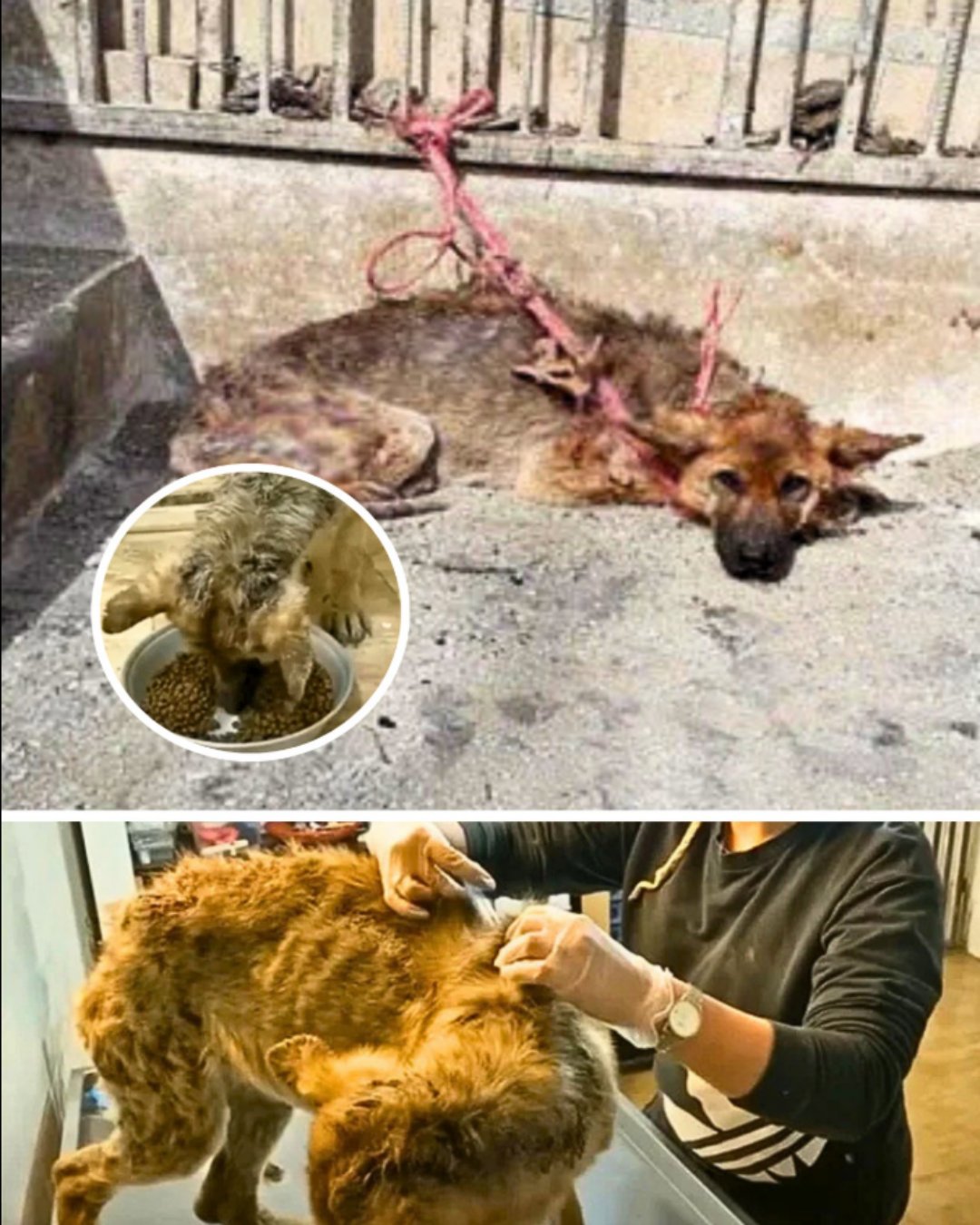
By the time Shirin finally came into our care, her condition told a story more devastating than any explanation could.
She was so weak that she could not even defend herself from red ants as they crawled across her body.
They bit into her fragile skin while she lay helpless, too exhausted to lift her head, too depleted to twitch away.
That image stays with you.
Not because it is shocking in a dramatic way, but because it is quiet.
It is the kind of quiet that happens when an animal has reached the edge of what she can endure and still remain alive.
Her fur was thin and patchy.
Her limbs were stiff with pain, the kind of stiffness that doesn’t come from age alone, but from injury and inflammation and days spent sleeping on hard ground.
Her eyes, once meant to be bright and alert, looked dulled by exhaustion, as if even looking up cost too much.
When we lifted her, she didn’t fight.Not because she trusted us, but because she had no strength left for fear.
Her body felt lighter than it should have, and in that weightlessness there was a warning—this was not a dog who could wait another week for help.
This was a dog who needed a miracle now.
At the veterinary clinic, urgency replaced all conversation.
Tests were ordered quickly, hands moving with the practiced speed of people who understand how thin the line is between life and loss.
Shirin was placed under warm blankets, her breathing monitored, her veins searched for a place to give her what she no longer had.
The results came back with the kind of numbers that make a room go still.
Shirin’s red blood cell count was dangerously low.
Her body did not have enough oxygen-carrying cells to keep her organs functioning safely.
Without intervention, she would not survive.
A blood transfusion was immediately necessary.
There was no “wait and see.”
There was no gentle easing into treatment.
This was a decision made in the sharp, clinical language of emergency care: transfuse now, or lose her.
It is hard to describe what it feels like to stand beside an animal receiving blood for the first time.
There is something sacred about it, something that cuts through the noise of the world.
Another life giving Shirin the chance to keep hers.
A quiet exchange that says, without words, you still belong here.
X-rays added another layer to her story.
Shirin had a fractured pelvis.
The injury was classified as minor and expected to heal with time, but “minor” does not mean painless.
It meant every movement she made—every attempt to stand, every careful step—had likely been threaded with discomfort for weeks, maybe longer.
And still she had survived.
Still she had walked streets looking for food.
Still she had endured rain.
Still she had carried herself through days that offered nothing but hardship.
Treatment became a careful balance of saving her life and easing her pain.
She was started on supportive medications.
She received fluids, nutrition, and the kind of monitoring that doesn’t allow the body to slip away unnoticed.
Her recovery would not be dramatic in the way people like stories to be dramatic.
It would be measured in small changes that only a watchful heart would recognize.
The first sign was her breathing.
It began to look less strained, less like a body fighting for each inhale.
Then there was her gaze, a fraction more present, a fraction less distant.
Then, slowly, her appetite—first hesitant, then a little steadier, as if her body was remembering what hunger felt like when it came with the possibility of relief.
But healing isn’t only physical.
Shirin had learned, for months, that the world was unreliable.
That hands passing above her head didn’t always mean safety.
That noise could come with danger.
That being noticed could sometimes be worse than being ignored.
So we moved gently.
We spoke softly around her.
We let her rest without demanding anything in return.
We allowed her to take in her surroundings at her own pace, because trust is not something you can rush, especially in a dog who has been tested by so much.
There were moments when she would flinch at sudden movement.
Moments when she would stiffen as if bracing for pain that might follow.
And then, just as quietly, moments when she would soften again, as if realizing that this time, nothing bad happened after the touch.
The days after a transfusion can feel like watching dawn return.
Not in a bright, instant way, but in gradual warmth.
Color returns where there was pallor.
Strength begins to flicker back into muscles that had been running on emptiness.
A body that was failing starts to stabilize, and the panic that hovered at the edges begins to loosen its grip.
Shirin’s pelvis fracture required patience.
She needed rest and controlled movement, the kind that protects healing bone while still keeping the body from weakening further.
She was supported, guided, protected from the instincts that might push her to move too quickly when she started to feel better.
That is another quiet cruelty of survival.
Animals don’t always rest when injured, because resting can mean starvation.
They move because they must.
They endure pain because pain doesn’t stop hunger.
They keep going because the world does not pause to let them heal.
As Shirin grew stronger, her personality began to reveal itself like a story unfolding.
She wasn’t loud.
She wasn’t demanding.
She carried herself with a kind of calm dignity, as if she had decided long ago that she would not let suffering turn her into something bitter.
One day, she lifted her head when someone entered the room and held that gaze a moment longer than before.
Another day, she allowed a hand to rest on her shoulder without tensing.
Then came the first tail movement—small, almost uncertain, like she didn’t want to believe happiness was allowed.
Those are the victories that don’t make headlines but change everything.
Because they are proof that a spirit can be bruised and still remain intact.
They are proof that hope can live under exhaustion, waiting for the smallest opening to rise again.
It would be easy to tell Shirin’s story as a simple before-and-after.
Before: suffering.
After: safety.
But the truth is more complicated, and more human than that.
Even in safety, Shirin had to unlearn fear.
Even with food available, she had to believe it would keep coming.
Even surrounded by care, she had to let her body accept that it could stop bracing for the next blow.
And the people around her had to learn something, too.
That cruelty doesn’t always look like violence.
Sometimes it looks like indifference.
Sometimes it looks like driving past.
Sometimes it looks like noticing an animal in the rain and deciding it isn’t your problem today.
Shirin survived that kind of world.
She survived the slow wearing down of neglect.
She survived an injury that made every step hurt.
She survived anemia so severe her body was slipping toward collapse.
She survived even when ants could crawl across her skin and she could not lift herself to fight them.
Now, she is learning what it means to live instead of simply endure.
To rest without fear.
To heal without rushing.
To look up and see a human hand as something that can comfort instead of harm.
There is still a road ahead, because recovery is rarely a straight line.
But Shirin’s story has already changed, and the change is not only in her body.
It is in the way her eyes return to the world.
It is in the quiet steadiness of a dog who has suffered deeply and still chooses, day by day, to keep going.
And maybe that is what makes her journey so unforgettable.
Not the broken pelvis.
Not the blood transfusion.
Not even the months of rain and hunger.
It is the fact that beneath all of it, something in Shirin refused to fade.
A small, stubborn hope that kept beating inside her even when her body was failing.
A silent message carried through every hard day: I am still here.