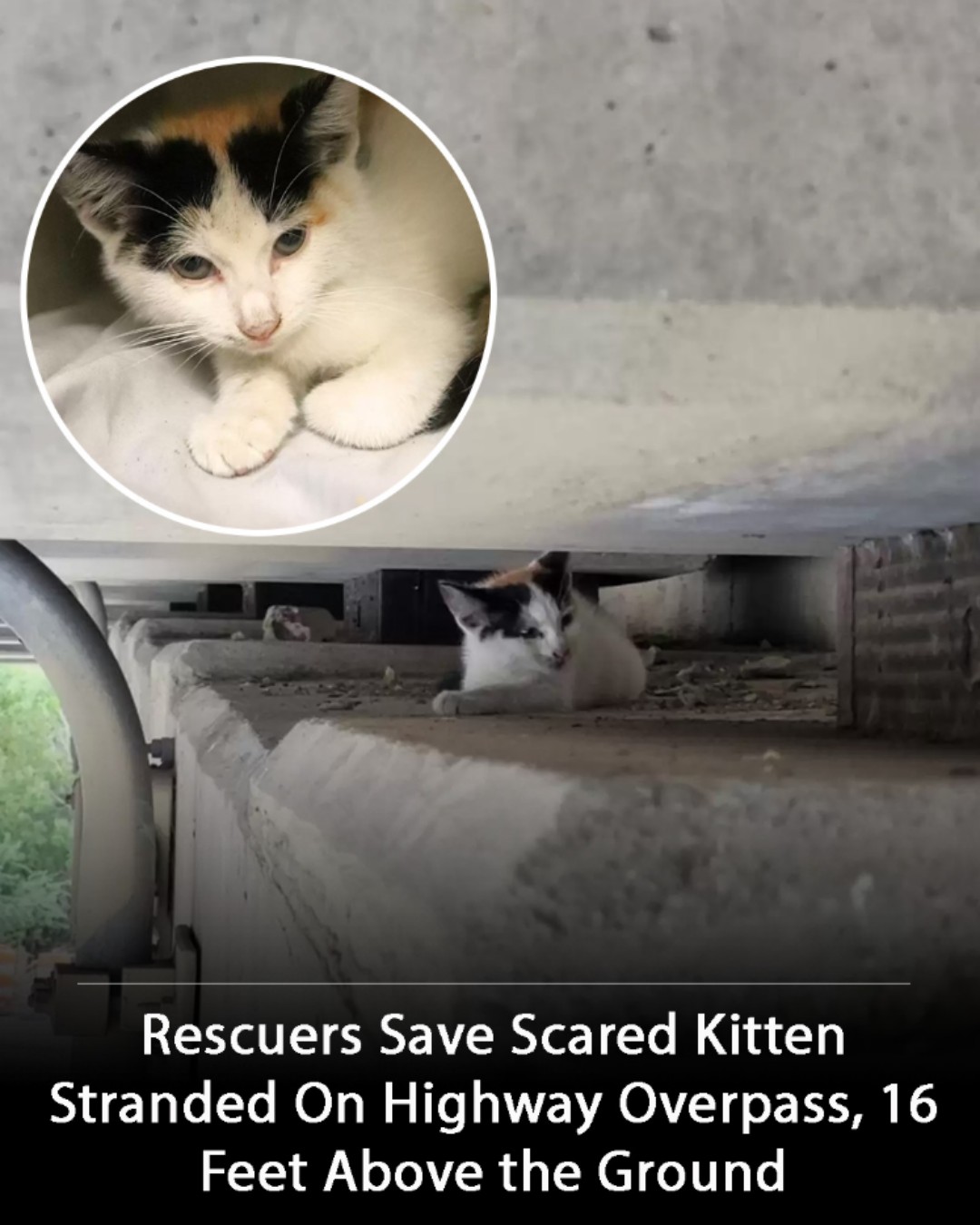
In the heart of San Antonio, Texas, where the hum of traffic and the towering concrete of highways rule the landscape, a story of hope and resilience began with a faint, desperate cry. A pedestrian, casually strolling beneath a busy highway overpass, froze in their tracks. What they heard was not the usual blend of city sounds—no honking cars or bustling crowds—but a soft, pleading cry from above. It was unmistakable. A tiny creature, stranded and scared, was calling for help. The source of the distressing sound? A small kitten, helplessly perched on a narrow 16-foot-high ledge, too frightened to move and with no clear way down.
This was no ordinary situation for the city’s animal care services. The urgency of the call sent ripples of concern through the San Antonio Animal Care Services (SAACS) team. Time was critical. The kitten—later named Zelda—was in a precarious position, above a fast-moving road with no escape. Her tiny voice was the only thing keeping her alive, her only chance for rescue.
The scene was chaotic. Zelda was stuck in a spot where she was neither close enough for an easy reach nor far enough for a simple rescue. Animal Care Officer Garcia was first on the scene, equipped with a net to coax the kitten down. Yet, Zelda, frightened beyond belief, darted back and forth across the ledge, her small body skittering just out of reach every time. Officer Garcia’s efforts were thwarted by the kitten’s fear and the unpredictability of the situation. With each failed attempt, the reality of the danger set in—the longer Zelda remained trapped, the higher the risk she faced.
But Garcia wasn’t alone for long. The team at SAACS knew how vital it was to work swiftly. Two more Animal Care officers arrived on the scene, bringing with them the necessary tools to make the rescue possible—a ladder and a humane cat trap. With the trio of officers in position, the team worked in harmony, carefully planning their next steps. They knew they had only one shot to get this right. The officers positioned themselves in strategic spots, ensuring that the kitten would have no way of escaping without being safely contained.
Zelda’s fear was palpable. The sound of her little paws skittering across the hard surface above echoed in the quiet moments of suspense, and the officers held their breath. Every second felt like an eternity. But the team’s teamwork and dedication paid off. Slowly, Zelda was coaxed into the trap, and the officers, working in perfect unison, gently lifted her from the ledge. A collective sigh of relief echoed through the air as the kitten was safely lowered to the ground. Zelda’s rescue was no longer a distant hope—it was a reality.
Once on the ground, the officers quickly transported Zelda to the SAACS shelter, where she could finally find peace after her terrifying ordeal. The shelter, a warm haven compared to the cold concrete ledge above a bustling highway, offered Zelda food, warmth, and a safe place to rest. But Zelda’s journey didn’t end there. While she had survived the ordeal, the emotional scars of the experience would take time to heal. Fortunately, a community of animal lovers was already on her side.
Word of Zelda’s dramatic rescue spread quickly, and soon, the Animal Defense League of Texas (ADLT)—a nonprofit organization dedicated to protecting animals—heard her story. Moved by the kitten’s miraculous survival, the team at ADLT knew they had to continue what SAACS had started. They stepped in, offering Zelda the continued care and attention she needed to fully recover from her traumatic experience.
At ADLT, Zelda’s journey began to take a new turn. She was given all the love and care she could ever need—medical checkups, playtime, and a safe space to heal physically and emotionally. The staff at ADLT worked tirelessly to ensure Zelda wasn’t just surviving, but thriving. They knew that beyond the scars of her past, Zelda deserved a future filled with joy, love, and the chance to live a life free from fear.
As days turned into weeks, Zelda’s transformation was nothing short of miraculous. The once terrified, trembling kitten who had clung to a narrow ledge above a busy road had blossomed into a playful, confident young cat. Her fur, once matted and dirty from her time stranded on the ledge, grew shiny and healthy. Her eyes, once filled with fear, sparkled with curiosity and trust. Zelda was no longer the scared kitten trapped on a highway overpass—she was a survivor.
But Zelda’s story didn’t end with her rescue. It was just the beginning of a new chapter in her life. ADLT had worked tirelessly to ensure Zelda had the best chance at a bright future, and as she healed, her true personality began to shine through. Her playful antics, sweet nature, and loving personality made it clear that she was ready for a family to call her own.
Her story, once one of fear and uncertainty, became one of hope and resilience. Zelda was given the ultimate gift: a second chance at life. And when the time came, she was adopted by a loving family who had been waiting for a furry friend just like her. The moment Zelda stepped into her forever home, the transformation was complete. She was no longer a kitten clinging to a ledge in terror—she was a beloved companion, full of life and love.
The rescue of Zelda serves as a reminder that even in the face of the most challenging circumstances, there is always hope. Thanks to the dedicated teams at SAACS and ADLT, Zelda’s story of survival has inspired countless people. Her rescue wasn’t just about saving an animal—it was about showing the power of compassion, teamwork, and the belief that every life, no matter how small, matters.
Zelda’s journey from a frightened kitten stranded on a ledge to a happy, healthy cat in a loving home is a testament to the incredible impact that animal rescue organizations can have. It’s a reminder that with a little bit of courage, a lot of teamwork, and the unwavering support of a community, miracles can happen. Zelda’s story is proof that no matter how dire the situation may seem, there is always hope—and with hope, there is always a chance for a happy ending.