The foam on my front door looked like a living creature the first time I saw it—bloated, pale, clinging to the frame as if it had crawled out of some chemical nightmare and died mid-escape. It was one of those late nights in downtown Portland, Oregon, the air sharp with winter and airplane fatigue still in my bones after flying back from Sacramento. For a second, I stood there in the hallway staring at that grotesque yellow mass, thinking maybe exhaustion had twisted my vision. But as I stepped closer, running my fingers gently along the hardened ridges of the expanding insulation, the truth hit me with the cold precision of a blade: someone had sealed my apartment shut. Deliberately. Personally. Angry enough to be sloppy, but still smug enough to think they’d get away with it. And when I leaned in, the faint chemical smell—sweet, plastic, artificial—told me this hadn’t happened long before I arrived.
The security camera above the hallway blinked its little red light at me, almost taunting. I knew then, with a kind of terrible clarity that settled deep in my chest, that this was no random vandalism. This was a warning. Or maybe a punishment. And only one person I knew would ever think something like this counted as a joke. Dylan.
But the real story—the one that started weeks before that hallway night—began at a dinner table forty minutes outside Portland, back in the suburban neighborhood where American flags hung on mailboxes and neighbors still waved through picket fences. It was the kind of place people imagined when they thought of safe, quiet U.S. living, but to me it had become a place layered with old guilt and expectations that clung like cobwebs I could never fully brush off.
That night—the night that detonated everything—started with a single sentence from my mother.
She placed one hand on the steering wheel and the other flat on the table as if pinning me down with the memory. “Calm as ice,” she’d said. “You won’t get a single cent.”
Those words had echoed in my skull long before the foam on my doorframe ever hardened. I didn’t even know yet that the betrayal I felt forming under my skin wasn’t the betrayal. Not the real one. Not the hit they’d rehearsed behind closed doors.
I’d told myself I was just going to dinner. Just lasagna, small talk, the usual dance of being the responsible daughter in a family that always needed something from me. I drove from downtown Portland out toward the suburbs, headlights slicing through the dark, radio low, the familiar ache in my chest building with each mile. You’d think after years working in fast-paced environments—deadlines, projects, cross-country conferences—I’d be immune to anxiety, but family is different. Family is a wound you keep touching because you’re convinced it’ll hurt less if you see it coming.
I pulled into their driveway—the same driveway where I learned to ride a bike, where my father taught me to check the oil in my first car. The porch light glowed warm and golden, the classic American welcome glow. Only I didn’t feel welcome. Not really. More like invited for a purpose.
The moment I stepped inside, the scent of garlic, tomatoes, and lemon cleaner hit me—memories of Friday cleaning days and Sunday dinners layered over each other. But something else lingered, something still and tense, like the air had been vacuum-packed.
My mother barely looked up from the oven. My father only gave me the curt nod he reserved for situations where he did not want to engage. Dylan and Laya—the twins—exchanged that silent, too-fast smile of people who knew something I didn’t.
I told myself not to overthink it.
The table was set perfectly, like a holiday spread. Cloth napkins folded with triangular precision. Candles already burning. Wine glasses gleaming. That level of perfection was never a good sign in my family. It meant an announcement was coming. And in America, people hide their ugliest truths inside the prettiest dinners.
We sat, we talked, awkwardly filling air with mentions of weather, work, repairs, projects—as if civility could change gravity. As if years of quietly transferred bills, late-night “emergency” calls, and unspoken obligations didn’t exist.
My mother watched me with a look I recognized too well—a calculating glint behind a gentle smile. Every time she’d handed me another bill—mortgage payments, Dylan’s tuition for his third abandoned major, money for Laya’s influencer equipment, repairs for the lake house—they always came wrapped in the phrase: “Family sticks together, Rebecca.”
And I had believed her. Because that’s what eldest daughters do in so many American families—they become the safety net, the unpaid therapist, the lender of last resort, the dependable one who never gets to fall apart.
Then came the moment that fractured everything.
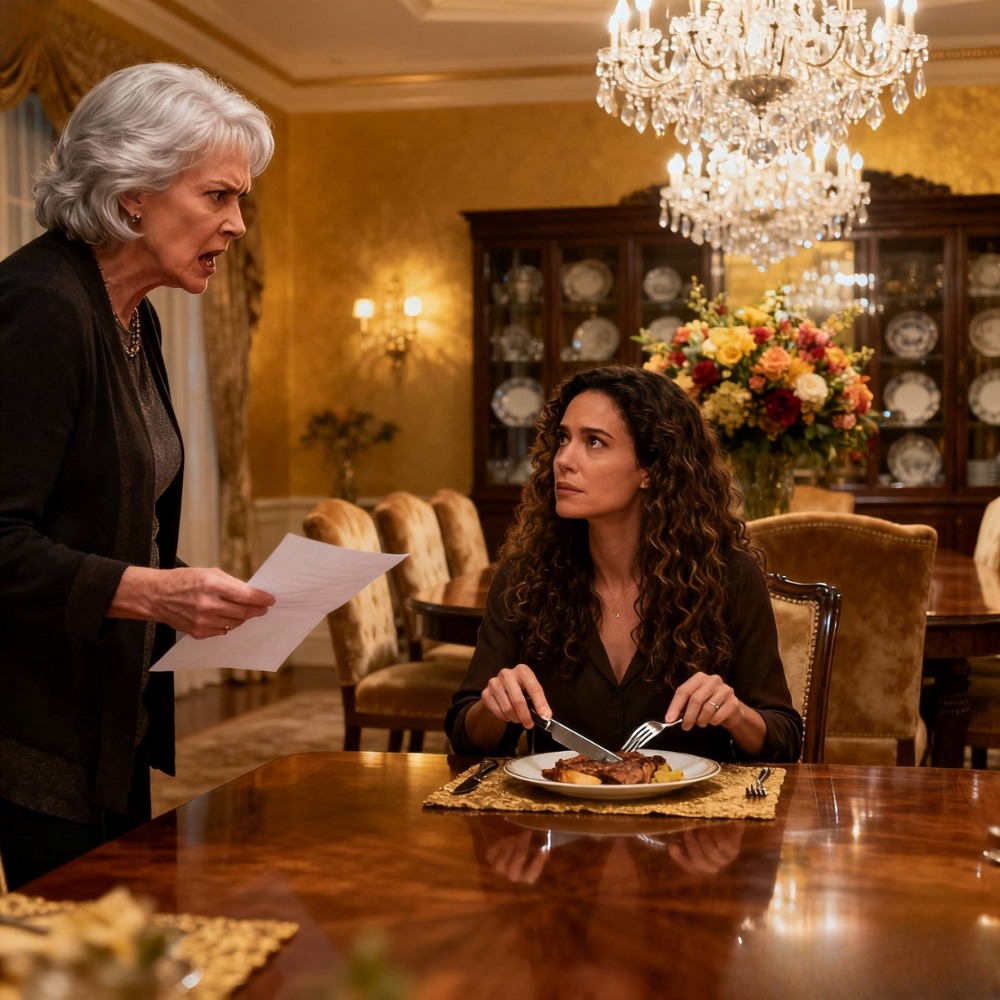
My mother cleared her throat and pulled out a thin folder from beside her plate. “Your father and I finalized the will,” she said. “We wanted you to hear it directly from us.”
The room seemed to tilt. Even the refrigerator hum faded.
“The house, the lake cottage, the savings,” she continued. “Everything will go to Dylan and Laya.”
For a heartbeat, I genuinely thought I misheard. But the smug look on Dylan’s face confirmed it. Laya’s little smile sealed it.
“I’m sorry,” I said softly. “You’re leaving me nothing?”
“You’re doing well on your own,” my mother replied, rehearsed, calm, patronizing. “You don’t need anything from us. But your siblings… they need support.”
Support. Meaning my money hadn’t been support—it had been expected tribute.
I listed everything I’d paid for. The mortgage. The bills. The cottage repairs. Dylan’s endless majors. Laya’s endless hobbies.
My mother sighed like I was being dramatic. “This is why we didn’t want to tell you. You always bring it back to money.”
“Because I’m the only one bringing money,” I said.
My father murmured, “Sweetheart, you’re stable. You live comfortably. You’ll be fine.”
The ache that hit me then wasn’t surprise. It was recognition. The kind that comes when you finally see the truth stripped bare.
Something inside me aligned, like a puzzle piece snapping into place.
“Fine,” I whispered. “Then don’t expect a single cent from me either.”
The room froze. Lasagna steam drifted upward like ghost breath. And I stood, walked away from the table, their blurred faces twisting behind me.
They thought the will was the betrayal.
They had no idea.
On the drive back to downtown Portland, the highway stretched like a ribbon through the dark Oregon woods. Rain streaked gold across my windshield. My mother’s voice replayed in my skull: You won’t get a single cent. A statement delivered with the coldness of someone convinced of her own righteousness.
When I reached my apartment—my sanctuary—I sat on the couch in the dim glow from the city outside my windows. My phone exploded with calls and texts: my mother, Dylan, Laya.
I didn’t answer.
Instead, I opened my banking app.
A decade of recurring payments stared back at me—mortgage transfers, utilities, mysterious charges labeled “help,” all quietly siphoned away because I had been too afraid of being the “bad daughter” to say no.
One by one, I canceled everything.
Cancel. Confirm. Cancel. Confirm.
It didn’t feel like revenge. It felt like breathing after years underwater.
When my phone buzzed again, I answered.
My mother’s voice was sharp. “What are you doing? Don’t you dare cancel those payments.”
“I’m not your bank,” I said.
“You’re part of this family!”
“You treated me like a resource, not a daughter.”
She gasped like I’d slapped her. “Call me when you’ve calmed down.”
She hung up.
Dylan called. “You’re freaking out over nothing,” he said. “No one forced you to help.”
That was the moment something inside me snapped so cleanly it almost sounded like a bone.
Laya called next, sighing dramatically. “Beck, seriously, you’re embarrassing yourself. You don’t need the inheritance. Let it go.”
I blocked her. And then I blocked all of them.
Silence filled my apartment like a new kind of air.
Weeks passed. Work consumed me. Travel to Sacramento. Projects. Deadlines. My life began to feel like mine again.
Then came the “family meeting.” My mother demanded I attend. “You owe us that much,” she wrote. Old programming tugged at me. I replied with one word: Fine.
But the real rupture didn’t come until after.
The night I returned from Sacramento, dragging my suitcase through the quiet hallway of my building, shoulders aching, eyes gritty—that moment when I saw my door sealed shut with foam—that was when everything sharpened into a point.
The security footage confirmed what I already knew.
Dylan. Hood pulled low. Same swagger. Same ignorance. Shaking the can like it was spray paint on a high-school dare. Filling every crack around my doorframe with gleeful carelessness.
I didn’t cry. Didn’t yell. I just hit “Save.”
Aunt Nora arrived in slippers and a messy bun, fury simmering under her breath when she saw the footage. “You can’t keep absorbing their damage,” she told me. “They will never stop unless you make them.”
So I filed a police report. Calm. Precise. American law might not fix broken families, but it does deal with property damage.
My mother screamed when she heard. “You’re destroying this family!”
“No,” I said. “I’m holding him accountable.”
Dad tried logic, excuses. Dylan called, his voice frantic. “It was a joke!”
“It wasn’t,” I told him. “I am safer without you.”
Laya cried. Manipulation disguised as concern.
I blocked all of them again.
When Dad finally asked, “What do you want?” I told him exactly what I wanted: reimbursement for the repairs.
He called it outrageous.
I said it was the price.
The transfer arrived the next morning.
“Settlement,” the memo read.
I stared at the screen for a long time. Not happy. Not victorious. But free.
My mother called again, voice shaking with rage. “You destroyed this family.”
“No,” I said gently. “I stopped letting this family destroy me.”
When the call ended, I put my hand on the new doorframe—smooth, clean, untouched—and for the first time in my adult life, I felt safe behind it.
Weeks passed. Aunt Nora kept me updated from afar—not gossiping, just checking in. My mother had taken a diner job across town. My father worked overtime at a hardware store. Dylan had quit another job, blaming the stress. Laya drifted from one half-idea to the next.
Their crises no longer belonged to me.
In my own life, everything slowed. Then it bloomed.
Work noticed my calm. My manager offered me a leadership track. I slept better. Ate better. Breathed better. And with the reimbursement money, I did something symbolic—I booked a two-week trip to Italy.
Florence felt like a dream—warm stone walls, narrow streets, golden light draped across the city like velvet. Every evening, I stood on a small balcony overlooking terracotta rooftops and felt pieces of myself falling back into place.
When I returned to Portland, I joined a hiking group. On my second Saturday, I met Alex—steady, warm, easy to talk to, no hidden expectations. He spoke to me like I was a person, not an ATM. Not a hero. Not a solution.
Just Rebecca.
Sometimes, late at night, I still felt echoes of old guilt—but they were shadows now, not shackles.
And the most surprising part? I didn’t miss my family. I missed the version of me who believed love meant self-erasure. But she was gone now. Someone stronger had taken her place.
I used to think walking away from family meant failure. Now I know it means survival. That night with the foam wasn’t the beginning of disaster—it was the beginning of freedom.
Because in the quiet after the storm, I finally built a life that belonged only to me.
Choosing yourself isn’t selfish.
It’s how you finally breathe.