The dining room of the Victorian house on Elm Street radiated a carefully staged warmth—one that welcomed some while deliberately excluding others. Amber light from a crystal chandelier glinted off a perfectly roasted duck, costly wine, and the rehearsed smiles of my son-in-law, Brad, and his domineering mother, Agnes Halloway. From the kitchen doorway, it felt like watching a play I had been intentionally written out of. Back there, the air was sharp with lemon detergent and the greasy aftersmell of the meal I had cooked myself.
“Brad, sweetheart, this duck is exquisite,” Agnes purred loudly enough to be heard through the swinging door. “Though the skin could be crispier. I suppose we shouldn’t expect restaurant quality from unpaid help.”
“She does her best, Mother,” Brad chuckled, his words soaked in expensive Merlot. “Mom! Bring the gravy boat—you forgot it.”
I lifted the silver gravy boat. My hands were steady—aged, veined, and marked by time, but unwavering. They hadn’t trembled in three decades, not since my second tour in Kandahar. I stepped into the dining room and placed it on the table. As I reached for the empty chair beside Brad, Agnes cleared her throat—sharp and deliberate.
“Evelyn,” she said, staring at her napkin instead of me, “we’re discussing private family matters. Brad’s promotion. Why don’t you eat in the kitchen? There’s plenty left on the carcass.”
I glanced at Brad. My daughter, Sarah, was working a double shift at the hospital. She believed I was staying here as a loved matriarch, recovering from what I had called a “minor stroke”—a convenient cover for an injury from a life she knew nothing about. She didn’t know her husband treated me like hired help, or that his mother saw me as disposable.
“Go on, Mom,” Brad said, flicking his hand dismissively. “And shut the door—the draft is irritating.”
I didn’t protest. In my former line of work, you never interrupt people when they feel powerful. You let them relax, let them believe they’re untouchable—right up until the moment that illusion collapses. I returned to the kitchen and ate cold leftovers from a paper plate, though hunger wasn’t what drove me. I was listening.
Something felt wrong. The house was too quiet. Earlier, I had asked about my four-year-old grandson, Sam, and Brad had brushed it off as a “time-out.”
Sam didn’t do quiet time-outs. He was chaos and laughter incarnate. Then I heard it beneath the dining room chatter: a soft, rhythmic sound. Scrape. Scrape. A sharp gasp. It wasn’t coming from his bedroom. It was coming from the closet under the stairs.
“He’s been in there two hours now,” Agnes whispered. “Do you think that’s enough?”
“He needs discipline,” Brad muttered. “Crying over dropped ice cream? Boys don’t cry. A little darkness builds character.”
My blood didn’t boil—it crystallized. They had locked a toddler in total darkness for hours. I folded my apron with care and set it down. Work was about to begin.
I moved silently into the hallway and knelt by the closet door. Inside, I heard rapid wheezing—panic breathing. Brad had installed a heavy slide bolt.
“Sam, sweetheart. It’s Grandma,” I whispered. A frightened whimper answered.
I didn’t touch the bolt. I planted my foot against the frame and pulled. The door splintered, screws ripping free as it burst open. The stench of fear and urine filled the air. Sam was curled tightly, eyes wide and unfocused.
“Gamma!” he cried, throwing himself into my arms. His small body shook violently—he was slipping toward shock.
Brad and Agnes rushed in. “What the hell are you doing?” Brad yelled. “You destroyed my door!”
“He’s four years old,” I said, my voice flat and cold.
“He was misbehaving!” Agnes snapped. “Put him back. He hasn’t learned anything yet.”
Brad stepped closer, towering over me. “Put him back, Evelyn. You’re undermining my authority.”
“Your authority ended the moment you tortured a child.”
He laughed. “Torture? He needs to toughen up—just like you. Always coddling him. That’s why he’s weak.”
I met his eyes and let him see the truth there—not frailty, but steel. “Move,” I said.
When he didn’t, I drove my shoulder into him. He staggered back in shock. I carried Sam to the couch, wrapped him in a blanket, and placed noise-canceling headphones over his ears, playing his favorite song.
“Grandma needs to fix something,” I murmured.
I locked every exit in the house. Click. Thud. Rattle.
“Are you insane?” Agnes shrieked. “Brad, call the police!”
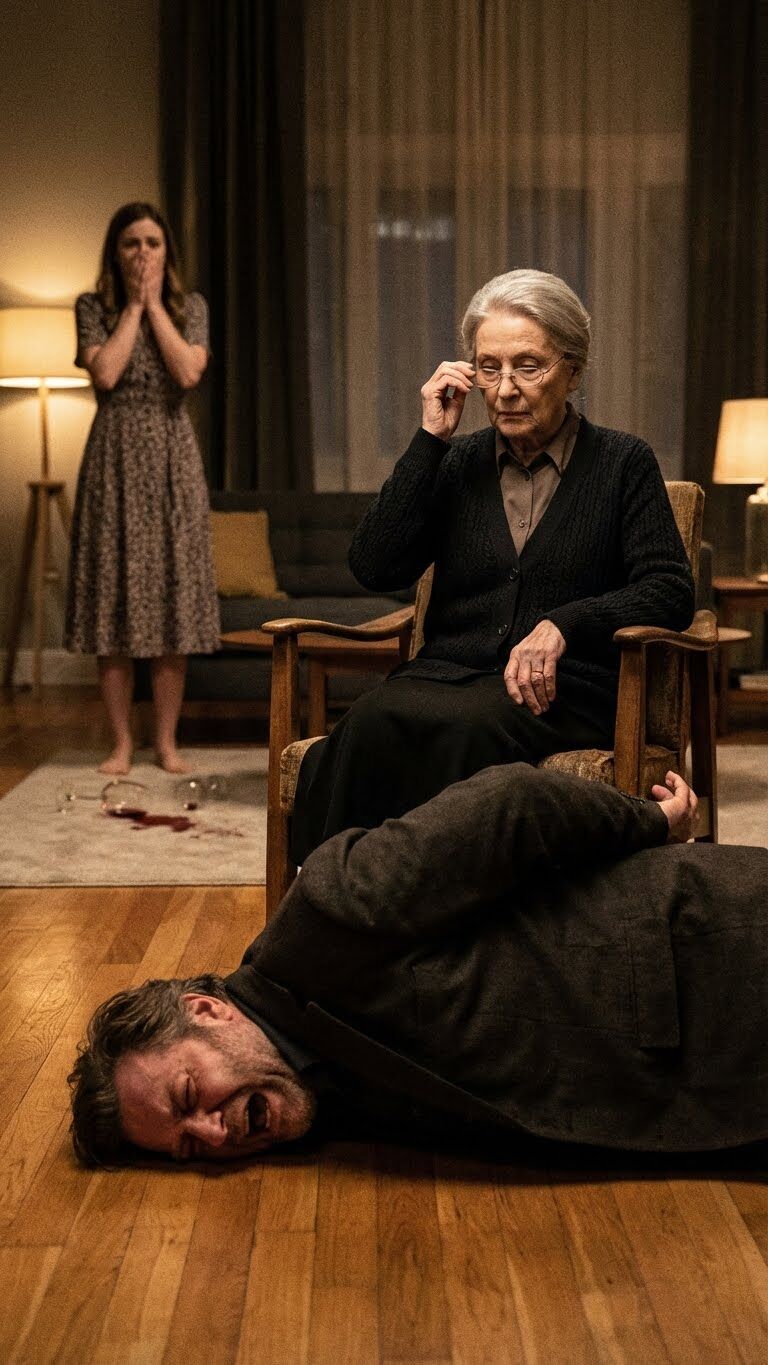
Brad reached for his phone. I crossed the room in seconds and struck his forearm, hitting the nerve. His hand went numb, the phone crashing to the floor. I swept his legs out and pinned him before he could react.
“Sit down, Agnes,” I ordered. She did.
I pulled a chair into the center of the room and sat calmly. “Before I was a grandmother,” I said, “I was a Level Five Interrogator for the Department of Defense. I specialized in extracting truth from men who believed they could endure anything.”
I removed a sunflower brooch from my collar—a tiny red light blinked. “Recorder. It captured everything. The slurs. The confession. Sam’s breathing.”
I lifted my burner phone. The call timer was already running.
“Sarah,” I said softly. “Are you listening?”
“I heard everything,” my daughter replied, her voice shaking with fury. “I’m on my way—with the police.”
Sirens wailed in the distance. Brad’s face drained of color. He spotted a fruit knife on the table and lunged.
“I’m not going to prison!” he screamed.
He never reached me. By the time the police forced the door open, Brad was face-down on the rug, and Agnes was sobbing. I gathered my sleeping grandson into my arms and stepped into the night.
The “weak grandmother” had completed the debrief.