Beneath the postcard perfection of Bali, life moves in layers.
There is the Bali visitors see—sunlit beaches, emerald rice terraces, incense drifting through temple gates, and smiles that feel as warm as the air itself.
And then there is another Bali, quieter and less photographed, where survival happens in alleys, at roadside corners, and beneath the relentless tropical sun.
This is the Bali where thousands of stray dogs roam each day.
They slip between motorbikes, nap in the shade of storefronts, and scavenge for food wherever luck allows.
Some were born on the streets.
Others were abandoned when they grew sick, inconvenient, or simply no longer wanted.
For most people passing by, these dogs blur into the background—another detail absorbed into the island’s constant movement.
For Rico, one dog refused to fade into that background.
It happened on an ordinary day, while navigating Bali’s busy streets.
Traffic hummed, horns echoed, and the air carried the scent of heat and exhaust.
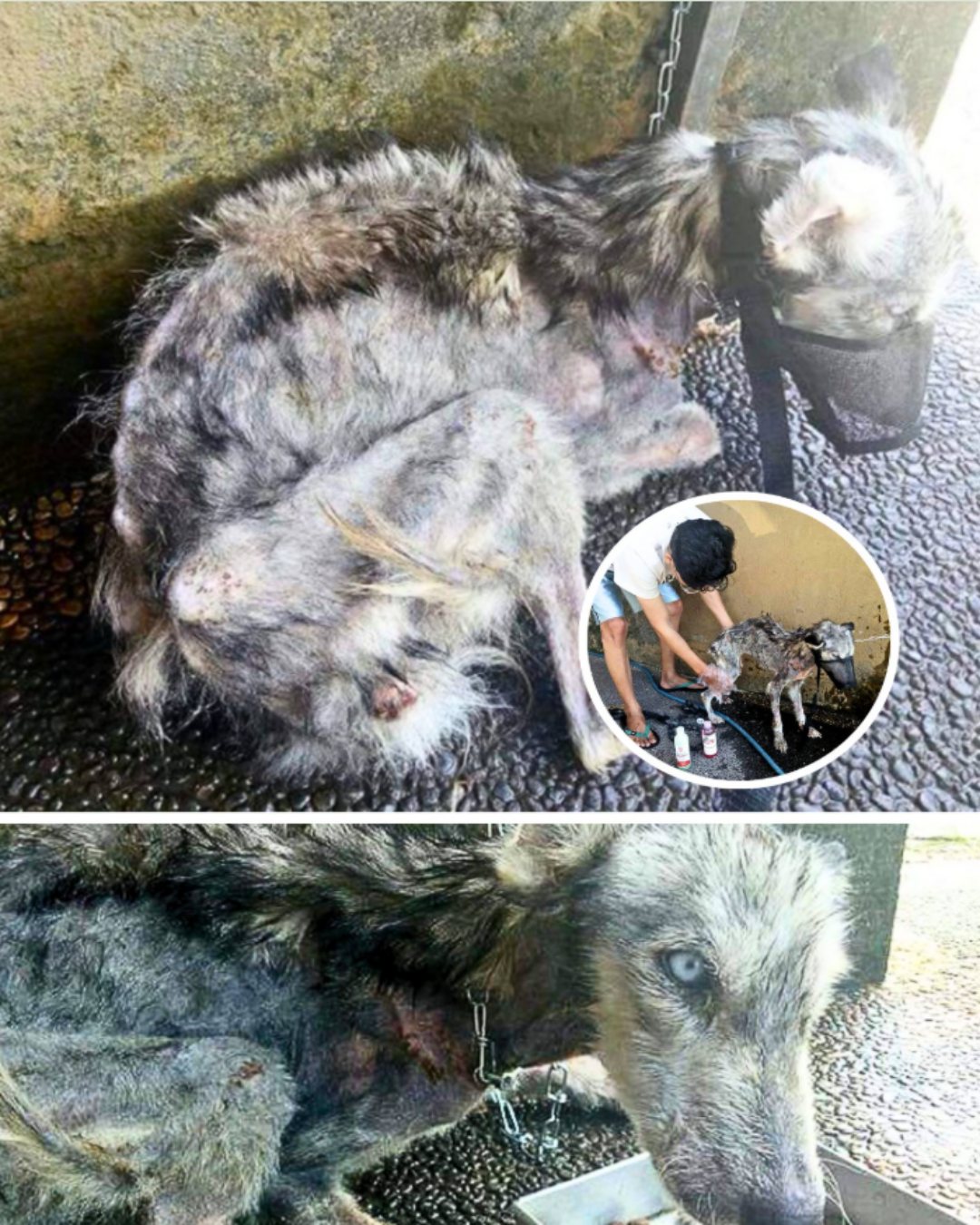
That was when Rico saw something that didn’t belong—a husky.
The sight alone was jarring.
Huskies are creatures of cold climates, bred for snow, endurance, and frigid air.
They are not meant to survive beneath a tropical sun that offers little mercy and no seasonal relief.
Yet there this dog stood, stranded in an environment that seemed to be working against him with every breath.
The husky’s thick coat had thinned into uneven patches.
His ribs pressed sharply against his skin, each one visible as his sides rose and fell.
His movements were slow, labored, and cautious, as though every step required negotiation with pain and exhaustion.
But it was his eyes that stopped Rico completely.
They were pale blue—striking, unmistakable, and deeply tired.
They held confusion, fatigue, and a quiet plea that needed no sound.
In those eyes was not aggression or fear alone, but a lingering question: Is anyone going to see me?
Many people would have looked away.
Some might have assumed the dog was aggressive.
Others might have decided he was too far gone, another tragic but inevitable consequence of life on the streets.
Rico didn’t see a lost cause.
He saw a life that still mattered.
Rico approached slowly, mindful of how street dogs learn caution early.
On the streets, hands often bring harm before help.
The husky stiffened at first, unsure whether this human meant danger or something kinder.
Rico didn’t rush him.
He spoke softly, kept his movements measured, and allowed the space between them to close on the dog’s terms.
Minutes passed.
Then more.
Eventually, the husky allowed Rico closer, his body tense but unmoving.
Up close, the reality became undeniable.
The dog was dangerously underweight, dehydrated, and showing early signs of heat-related illness.
His grooming had been neglected for so long that his coat offered little protection from the sun it was never designed to face.
Yet despite everything, he leaned slightly toward Rico’s hand.
It was a small movement, almost imperceptible—but it carried enormous meaning.
Taking a stray dog home is never a simple choice.
It demands time, money, patience, and emotional resilience.
There are vet visits, unexpected costs, behavioral challenges, and the possibility of heartbreak.
Rico didn’t hesitate.
He lifted the husky gently and brought him home, determined to give him something the streets never had—stability.
The first days were about survival, not transformation.
Fresh water was offered slowly, carefully, to avoid shocking a body that had gone without for too long.
Food came in small portions, spaced out to help a fragile system recover.
The husky ate cautiously at first, as if unsure the next meal would actually come.
At home, he slept longer than Rico thought possible.
Hours stretched into entire days, his body finally allowed to rest without needing to stay alert for danger.
Each breath seemed deeper than the last, each nap a quiet surrender to safety.
Vet visits soon followed, confirming what Rico already knew.
The husky’s condition reflected long-term neglect compounded by an environment completely unsuited for his breed.
He was overheated, malnourished, and emotionally worn down.
But there was good news too.
He was alive.
And he wanted to live.
Recovery didn’t happen overnight.
Weight returned slowly.
Energy came back in cautious waves rather than bursts.
The husky began to explore his surroundings, first with hesitation, then with growing curiosity.
He followed Rico from room to room, as if needing reassurance that this new world wouldn’t vanish without warning.
With time, his personality emerged.
He was gentle, observant, and deeply affectionate.
He learned routines quickly, taking comfort in predictability—regular meals, quiet walks, soft words.
The dog who once stood motionless in traffic now wagged his tail at the sound of Rico’s footsteps.
For Rico, the transformation was emotional in ways he hadn’t anticipated.
Saving the husky didn’t feel like a single heroic moment.
It felt like hundreds of small, intentional choices made every day—to show up, to care, to keep going even when progress felt slow.
The husky, in turn, gave something back that couldn’t be measured.
Trust.
Not the easy kind given freely, but the hard-earned trust built through consistency and patience.
Each time he rested his head against Rico’s leg or followed him into another room, it felt like a quiet acknowledgment: You didn’t leave.
Stories like this are not rare in Bali.
They simply don’t make the brochures.
For every rescued dog, countless others remain unseen.
They navigate heat, hunger, illness, and indifference daily.
Their lives unfold alongside tourists, locals, and traffic, often unnoticed unless someone chooses to stop.
Rico’s decision didn’t change the entire system.
It didn’t erase the larger problem of stray animals on the island.
But it changed one life completely—and in doing so, changed his own.
The husky no longer belongs to the streets.
He no longer stands alone beneath a sun that never gave him mercy.
He belongs to a home, a routine, and a human who chose compassion over convenience.
In a place known for beauty and tranquility, this rescue story reminds us of a quieter truth.
Sometimes the most meaningful journeys don’t involve beaches or temples or sunsets at all.
Sometimes, they begin with noticing what others walk past—and deciding that one life is enough to make stopping worthwhile.
Rico didn’t set out to become a rescuer that day.
He simply refused to look away.
And for one husky under the tropical sun, that choice made all the difference.