The chandelier above the grand foyer glimmered like a frozen firestorm, each crystal catching the late-afternoon sun pouring through the high windows of the Moretti estate in upstate New York. It cast scattered rainbows along the marble floor—beautiful, fractured pieces of light dancing in a house that, at that very moment, was hiding something ugly, something trembling, something that would twist the fate of everyone inside. And in the center of that glittering floor lay a single red crayon, snapped sharply in two, as if the house itself had bitten it.
That broken crayon was the first thing Lorenzo Moretti saw when he burst through the front doors.
Not the polished gold banister, not the towering bouquet he paid a florist in Manhattan to refresh every two days, not even the silent row of framed family photos lining the hallway—just that little, broken crayon lying abandoned on the marble. And somehow, instantly, it felt like an omen.
Ten minutes earlier he had been in midtown Manhattan, seated at the head of a sleek conference table inside the office suite he used as his “legitimate” business front. His lieutenants—men who carried fear the way others wore expensive suits—sat around him discussing disputed distribution routes. Nothing unusual. Nothing personal. Nothing that should have reached into his home.
Then his phone vibrated.
It would have gone ignored—during meetings it always did—if not for the second vibration that followed instantly, then a third. The maid’s name flickered on the screen. Rosa. Quiet Rosa, who never called unless the world was ending.
He answered, and the sound that poured from the speaker nearly stopped his heart.
“Sir… please come home. Please. She’ll destroy her. Please—please, hurry…”
Her voice trembled like glass under pressure.
And in the background—God help him—he heard crying. Small, cracked, smothered crying. Crying he knew.
His daughter.
Maria Elena.
Eight years old. The last living echo of his first wife. The only pure thing in his world.
He did not remember leaving the conference room. He barely remembered the elevator ride down or the streets fogged with winter air. Only the steering wheel beneath his hands as he drove too fast, too recklessly, and the single thought beating rhythmically with his pulse:
Please, let her be okay.
When he finally crossed the estate’s secure gate and threw the car in park, the air felt wrong. Still. Heavy. As if the house—the mansion that had hosted Christmas mornings, birthday parties, piano recitals—was holding its breath.
Rosa appeared in the foyer before he could call for her. Pale. Shaking. Eyes still wet. Hands twisted nervously around the hem of her apron.
“Where is she?” he demanded.
“In the parlor… for almost an hour,” Rosa whispered. “I wasn’t allowed near them.”
The chandelier overhead sparkled beautifully, oblivious to the nightmare happening beneath it.
Lorenzo started down the hallway.
With each step, he heard them more clearly.
A woman’s sharp, furious voice.
A child’s tiny, broken whimpers.
And then the unmistakable sound of paper ripping.
The kind of ripping done slowly, deliberately, to hurt someone more than the object itself.
He knew Isabella’s voice. He knew her anger. But this—this tone, this venom—he had never heard it directed at his daughter.
Maria Elena, who still slept with a nightlight.
Maria Elena, who saved half her Halloween candy to share with him when he got home late.
Maria Elena, who once cried for twenty minutes because she accidentally stepped on a ladybug in the garden.
His little girl.
He reached the parlor doorway.
And froze.
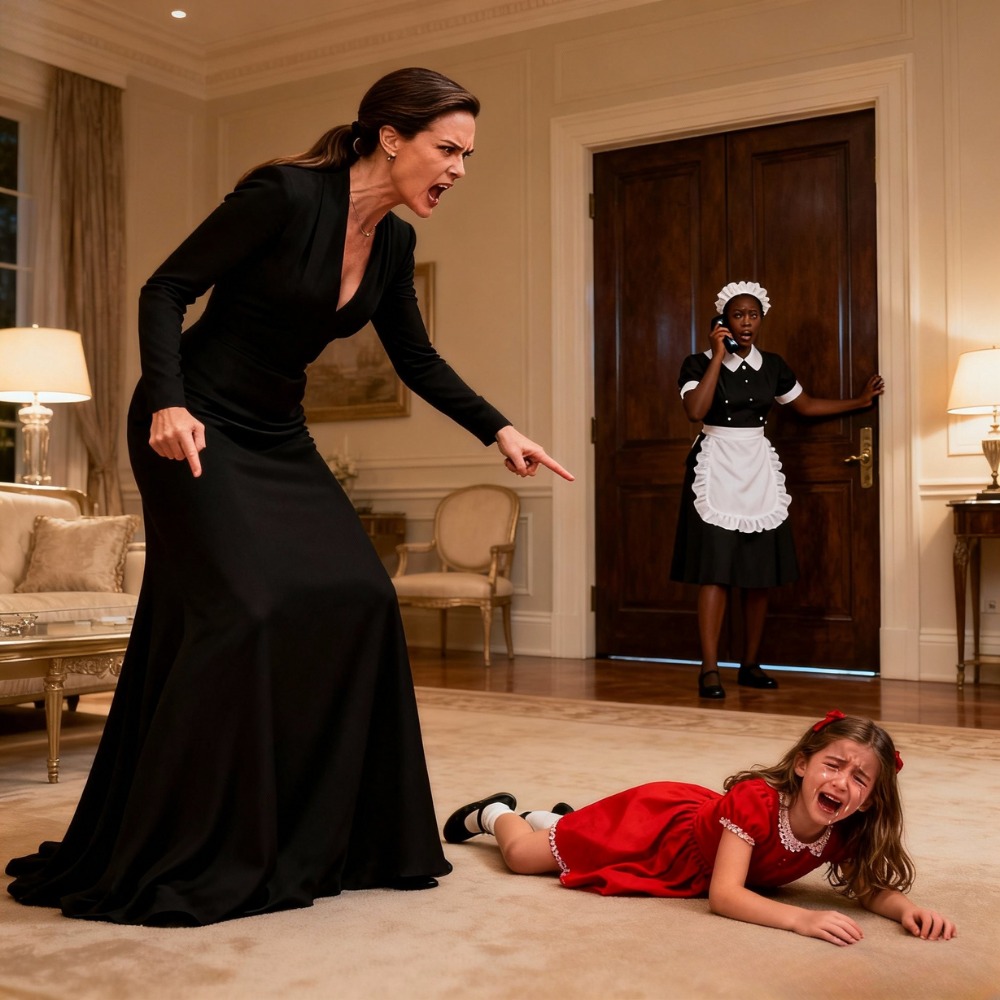
Isabella Moretti—his second wife, the woman who had swept into his life three years earlier like a glamorous hurricane—stood in the center of the room. Her designer dress was wrinkled, her perfect blowout undone, her eyes wild. Pages from one of Maria Elena’s school notebooks lay in shredded piles around her heels.
Maria Elena, wearing her blue school uniform, was pressed against the far wall. Her small shoulders shook with silent tears. Her hair clung to her forehead. Her wrists—God help him—were blotched red where fingers had clearly dug in hard.
“Maybe this will finally teach you,” Isabella hissed, tearing another page from the notebook, “not to ruin things that don’t belong to you.”
“It was an accident,” Maria Elena whispered. “Please—I’m sorry—I didn’t mean to spill the water—”
A cold, brittle laugh cracked from Isabella’s throat.
“Sorry doesn’t fix antique furniture. Sorry doesn’t make you less careless. Sorry doesn’t make you less… useless.”
The word hit the child like a slap.
Lorenzo stepped into the parlor then, but silently—like a predator, like a shadow.
He watched.
He listened.
And his soul felt like it was splitting open.
Because this was not the first time.
His daughter flinched too quickly. Cowered too naturally. The pattern was practiced. Learned. The fear engraved into her posture.
How long… how long had he missed this?
“Your father doesn’t need your drawings,” Isabella continued, ripping page after page. “He has real work, real people, real responsibilities. Not childish scribbles he’ll pretend to like so you stop whining.”
Maria Elena tried to cover her ears with both hands.
Isabella snatched her wrists.
Maria Elena gasped in pain.
Lorenzo’s vision burst into a cold, murderous white.
He stepped forward.
Isabella spun around. Her expression transformed instantly—rage melting into false innocence like she had flipped a switch.
“Oh! Lorenzo—you’re home. Thank God. She has been impossible today.”
He ignored her.
He went to his daughter.
He bent down—slow, gentle, careful, the opposite of everything happening in that room.
“Princess,” he whispered. “Come here.”
Maria Elena didn’t run to him.
She collapsed into him.
She buried her face in his neck and sobbed silently, shaking as though she feared she wasn’t allowed to cry.
“I’m sorry, Papa. I tried to be good. I tried so hard…”
“Shh,” he whispered, stroking her hair. “You did nothing wrong.”
Nothing.
Not one single thing.
He lifted her carefully, as if the slightest pressure might hurt her more, and handed her to Rosa, who stood shaking in the doorway.
“Take her to the kitchen. Stay with her. Make her something warm.”
Rosa nodded quickly, holding Maria Elena close as though shielding her from the world.
When they disappeared into the hall, Lorenzo turned.
For the first time in their entire marriage, Isabella took a step back from him.
“You don’t understand,” she said, her voice rising again. “She ruined my table—do you know how much that table cost? She needs discipline, Lorenzo. She needs—”
“Quiet.”
The word wasn’t loud.
But it struck her like a physical blow.
He’d used that tone in alleyways, in boardrooms, in back-rooms of neon-lit bars where deals were sealed with handshakes that meant life or death. He had never used it on her.
Not until now.
He approached slowly.
Predatory.
Controlled.
Deadly.
She tried again.
“I’m only teaching her structure—”
“By calling her worthless?”
Isabella didn’t answer fast enough.
That was her first mistake.
“By telling her I don’t have time for her?” he pressed.
Still no answer.
Her second mistake.
“By saying her mother—the woman who died giving birth to her—was weak? Worthless? Pathetic?”
Isabella inhaled sharply, chin lifting with brittle arrogance.
“She is too attached to that dead woman. Someone had to teach her the truth.”
Lorenzo’s heart went still.
Not stopped.
Stilled.
The way the ocean stills right before a hurricane touches down.
He walked to his desk, opened a drawer, and pulled out a thick manila folder. Papers spilled across the polished surface. Bank records. Phone logs. Security cam timestamps.
Isabella frowned.
“What is that supposed to be?”
“My insurance,” he said quietly.
Her brows knitted.
“I’ve been investigating you for six months.”
The color drained from her face.
“You—you’ve been spying on me?”
“I’ve been protecting my daughter,” Lorenzo corrected.
He pressed a button under the edge of his desk.
The hidden speakers in the parlor clicked.
And then her voice—her real voice—filled the room.
Stop sniveling, you pathetic little brat…
Your father doesn’t want you…
Your mother is dead because she was weak…
Every word echoed through the room like a confession carved in stone.
Isabella’s knees trembled.
“Turn it off,” she whispered.
“No.”
Her breathing quickened.
“I said turn it OFF!”
He stepped closer.
“You’re going to listen to every second of what you did.”
The recordings continued—audio knives slicing through the air. Maria Elena crying. The thud of something thrown. Isabella’s voice, cold and methodical, slowly destroying the confidence of a child who still slept with stuffed animals.
When the final clip played, the silence afterward felt suffocating.
Six months’ worth of cruelty had been poured out between them.
And now it lay there, naked.
Raw.
Undeniable.
“You don’t get it,” Isabella burst out suddenly, voice cracking under the weight of her collapsing world. “Do you know what it’s like being married to you? Do you know the pressure? I had to be perfect. I had to be beautiful. I had to be strong—stronger than your dead wife—stronger than that girl—”
“By hurting her?” Lorenzo asked.
His voice was deathly calm.
“You took your insecurities out on an eight-year-old?”
“She was in the way,” Isabella screamed, finally losing the polished veneer she’d worn like armor. “Everything was about her. Every schedule. Every decision. Every holiday. Every moment. I’m supposed to be your wife—not second place to a child who can’t stand on her own without crying!”
The truth spilled from her like poison.
It didn’t hit him the way she expected.
It hit him as clarity—as realization—as the final missing puzzle piece.
“You never loved her,” he said. “Not for a single day.”
“Love?” Isabella spat. “What she needs isn’t love. She needs to be molded. Hardened. Prepared for the real world. The world isn’t gentle, Lorenzo. Someone had to toughen her up.”
He stepped closer.
She stepped back.
“By breaking her spirit?”
“It would have been rebuilt stronger.”
“By teaching her fear?”
“Fear keeps people sharp.”
He shook his head.
“No, Isabella. It crushes them.”
She backed into the desk.
He didn’t raise his voice.
He didn’t threaten her.
He simply said:
“Get out.”
Her mouth fell open.
“Lorenzo—you can’t be serious—we can fix—”
“You have one hour to pack. Rosa will supervise.”
“You can’t throw me out—I’m your wife—I have rights—”
“The prenup disagrees.”
He walked past her toward the door.
The chandelier in the foyer still glittered beautifully, all rainbow shards and sparkling reflections, indifferent to the destruction unfolding beneath it.
Before he stepped into the hallway, he said, without looking back:
“You hurt my daughter. And that is the only unforgivable sin in this house.”
Isabella sank into the nearest chair as though her bones had given out. For the first time since he’d met her, she looked small. Not glamorous. Not powerful.
Just small.
Alone.
Defeated.
And terrified of a life without the man she thought she could control.
Lorenzo left the parlor and returned to the one place in the world she would never be welcome again.
His daughter.
She sat at the kitchen counter, a warm mug of hot chocolate cupped between trembling hands. She looked up when he entered—and her eyes, dark and soft and still glossy with tears, widened with hesitant hope.
“Papa… is she mad at me? I didn’t mean to spill the water. I was only trying to draw—”
He crossed the room and pulled her into his arms.
“No, princess. She’s leaving. You’re safe.”
She blinked in confusion.
“Leaving… forever?”
“Yes.”
Maria Elena stared at him—searching, uncertain, as if afraid this was a dream she wasn’t allowed to believe in.
“Just us?” she whispered.
He kissed her forehead, holding her tight enough to promise safety but gentle enough to protect her bruises.
“Just us,” he said. “Always.”
And for the first time in months, the house exhaled.
The air warmed.
The chandelier’s rainbow reflections danced again—no longer fractured, but hopeful.
The Moretti mansion—this American palace built on money, danger, and ambition—felt alive again.
Because the monster had been removed.
And the little girl who once feared every creaking floorboard finally leaned into her father’s chest and allowed herself to breathe