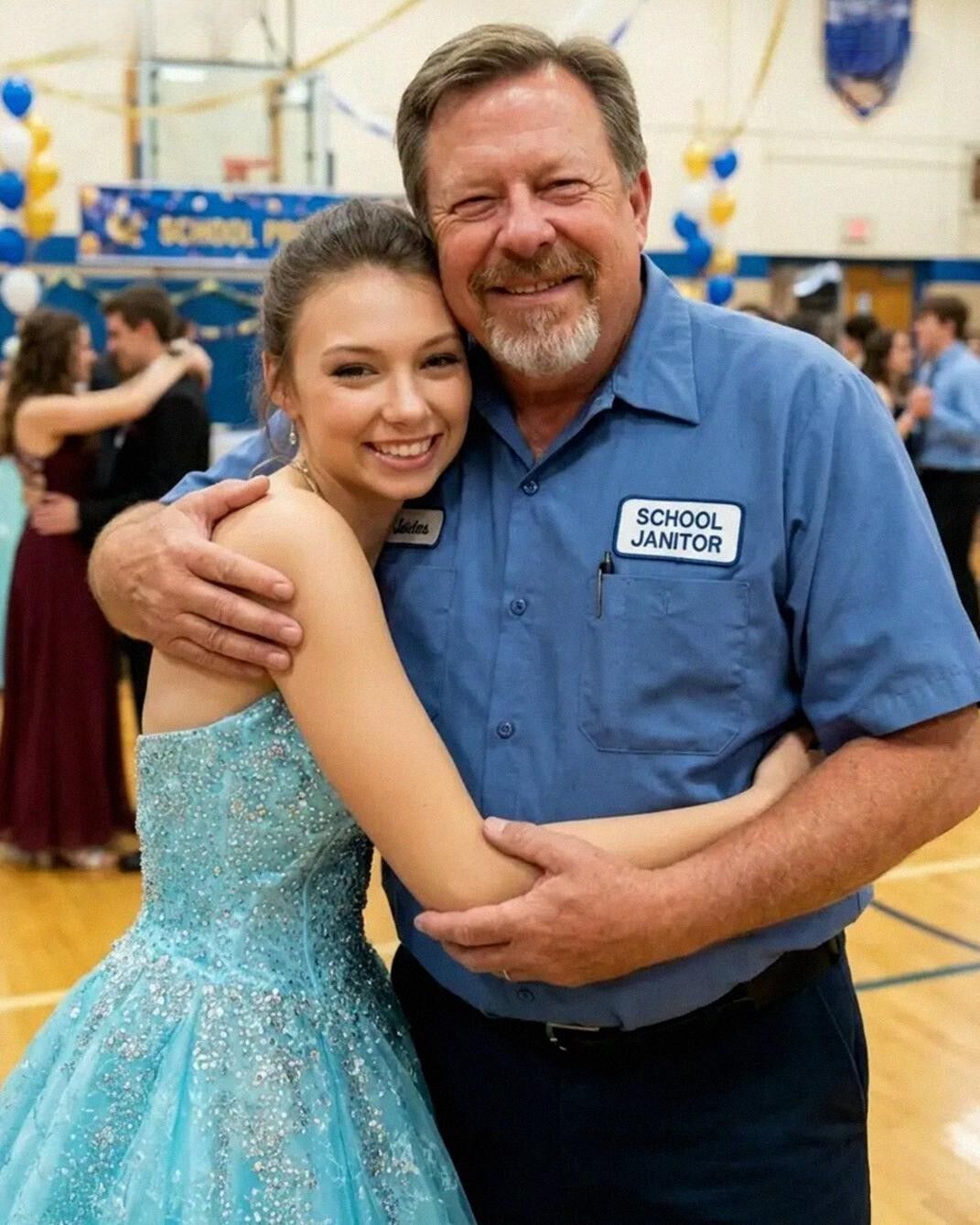
In the sterile, fluorescent-lit hallways of my high school, I wasn’t just Brynn—I was a joke. For four years, I carried names I never deserved: “Mop Princess,” “Sweeper Girl,” “Trash Baby.” The reason was painfully simple. My father, Cal, was the school janitor. He was the man who emptied overflowing trash cans, scrubbed cafeteria floors after food fights, and stayed late repairing lockers students destroyed out of boredom and anger.
The mockery started during the second week of freshman year. I was at my locker when Mason, a boy whose privilege was louder than his voice, yelled down the hall, “Hey Brynn! You get extra trash duty today or what?” Laughter exploded around me. I laughed too—thin, forced, defensive—hoping that joining in would dull the pain. It didn’t. From that moment on, my identity became inseparable from my father’s utility cart.
By sophomore year, the shame had settled deep. In the cafeteria, a senior shouted, “Hey Brynn, is your dad bringing a plunger to prom so we don’t clog the fancy toilets?” The room roared. I stared at my lunch tray, my ears burning with humiliation. That night, I scrolled through my Instagram and deleted every trace of my dad—every selfie of him in his work shirt, every caption that said Proud of my old man. I scrubbed my digital life clean, as if I could erase the grease and grit of his job. At school, if I saw him pushing his cart, I slowed down, letting other students form a wall between us. I was fourteen and terrified of being the punchline.
My father never let their cruelty harden him. He endured the shoves, the insults, the kids who deliberately knocked over his bright yellow “Caution: Wet Floor” signs. He would just smile, pick them back up, and keep working. At home, he was my constant. My mother had died in a car accident when I was nine, and since then, he took every overtime shift he could to keep us going. Some nights I woke to find him at the kitchen table, a single light illuminating stacks of bills and an old calculator.
“Go back to sleep, kiddo,” he’d say gently. “Just wrestling some numbers.”
When senior prom approached, the school buzzed with talk of dresses, limos, and lake-house after-parties. I told my friends prom was stupid—that I wasn’t going. The truth was, I couldn’t stand the idea of my dad cleaning up after the same people who humiliated him. Then, a week before prom, my guidance counselor, Ms. Tara, called me into her office.
“Your dad has been here until ten every night this week,” she said quietly.
I assumed it was routine janitorial work, but she shook her head.
“He’s volunteering to help set up the prom—hanging lights, taping cables. He said he wanted everything perfect for the kids.”
That night, I found my dad at the kitchen table again. This time, his notebook listed different things: Rent. Groceries. Gas. Brynn’s dress?
I pulled it toward me. He startled, trying to hide it.
“I was just seeing if I could make it work,” he said softly. “If you wanted to go. I could pick up another shift.”
“I’m going, Dad,” I whispered, my voice breaking. “I want to go.”
We drove two towns over to a thrift store where no one knew us. I found a simple dark-blue dress that moved like water. When I stepped out of the dressing room, my father’s eyes filled with tears.
“You look just like your mom,” he said.
He paid before I could even look at the price.
Prom night arrived in a blur of nerves. Dad wore a plain black suit that pulled slightly at the shoulders. He was working the event, managing spills and trash.
“I’ll be invisible,” he promised on the drive there. “You won’t even notice me.”
But the comments started the moment we arrived.
“Isn’t that the janitor’s kid?”
“She actually came?”
Inside the gym, I saw my father near the door holding a heavy trash bag. A girl walked past him, wrinkled her nose, and whispered, “Why is he even here? This is so awkward.”
Something in me broke. I didn’t see a janitor. I saw the man who raised me alone. The man who stayed up late so I could have everything I needed. I didn’t go to my table—I went straight to the DJ booth.
“Cut the music.”
The song stopped mid-chorus. The room turned toward me. My hands shook as I grabbed the microphone and pointed to the man in blue gloves at the back.
“I’m Brynn,” I said. “You know me as the janitor’s daughter. You’ve spent years making jokes about me and my dad. But look at him. He’s been here every night this week setting this up for you—for free. He cleans what you destroy. He fixes what you break. And when my mom died, he worked double shifts for years so I’d never feel like I was missing anything.”
The gym was silent.
“I spent years being ashamed,” I continued. “I hid him. I hid myself. But tonight, I’m done. I’m proud he’s my father. And if you think his job makes him less than you—then you are nowhere near the person he is.”
I stepped off the stage.
After a long pause, Luke—the boy who made the plunger joke—walked toward my dad. He straightened his tie.
“I’m sorry, sir,” he said. “I was wrong.”
Others followed. Apologies rippled through the room. Then the principal took the broom from my father’s hand and told him he was off the clock. The applause that followed was loud, raw, and real.
We left before the final song. Outside, the night smelled like rain. By the car, my dad leaned against the door.
“Your mom would’ve loved that,” he whispered.
“I’m sorry,” I said. “For ever being ashamed.”
He smiled, tired but warm.
“I never needed you to be proud of my job. I just wanted you to be proud of yourself.”
The next morning, my phone overflowed with apologies and posts calling my dad a hero. I watched him in the kitchen, humming as he made coffee, already dressed for work. And I understood something clearly at last: they laughed for years—but I got the final word.