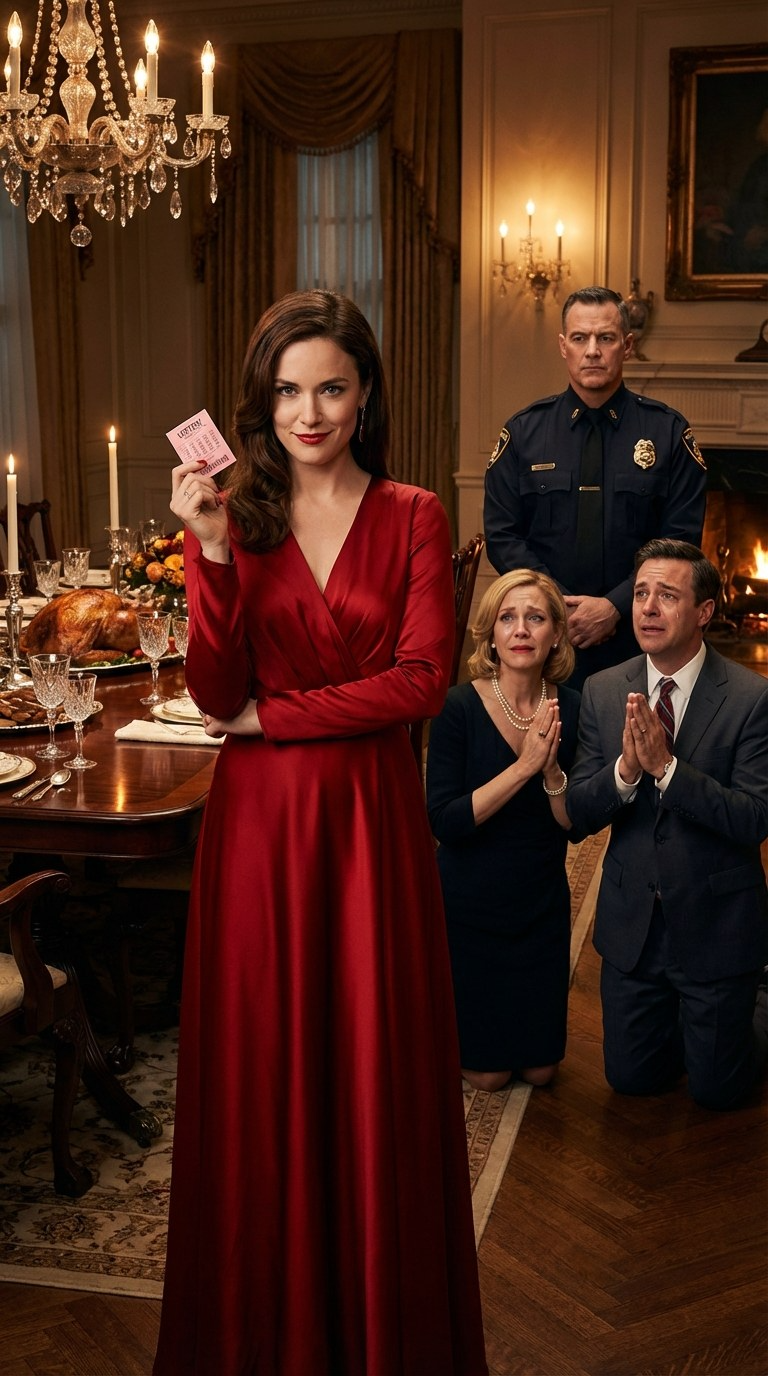
I am Audrey Crawford, and for thirty-two years, my value was set at exactly two dollars—the cost of a lottery ticket. It was my mother’s favorite gesture of dismissal, a reminder that in her eyes I was merely the “stagehand” to my sister Vivien’s starring role. The Crawfords thrived on the illusion of importance: my father, Gerald, ruling from his leather recliner, and my brother-in-law Marcus weaving lies in tailored Italian suits.
This past Thanksgiving, the house was heavy with the smell of roasted turkey and unresolved bitterness. I arrived carrying deep burgundy dahlias I had spent months growing, only for my mother, Patricia, to glance past me toward the driveway, hoping someone more impressive would appear.
“Still playing with plants,” she said with a sigh.
As always, I became invisible labor—folding napkins, refilling glasses—while the family clustered around Marcus, a so-called “consultant” whose success always felt slick and unstable.
The truth surfaced in the kitchen. I overheard the plan: a first-class Caribbean cruise for everyone. My parents. Vivien. Marcus. The kids. Even Grandma Grace. When Vivien asked about me, my father didn’t hesitate.
“She’s busy with her landscaping,” he said coldly. “She doesn’t fit the dynamic.”
They never even considered inviting me. I was written out entirely.
When I confronted them, there was no remorse—only ridicule. My father handed Vivien a gold envelope holding a thirteen-thousand-dollar vacation. Then my mother passed me a thin white envelope, her eyes sharp with satisfaction. Inside was a single Mega Millions ticket.
“Maybe luck will find you,” she said, sneering, “since ambition hasn’t.”
Marcus laughed, joking that I might win enough to buy a new shovel. I didn’t collapse. I solidified.
The real betrayal revealed itself later that night in my father’s study. While cleaning, I discovered a loan agreement for $180,000 at a predatory 32% interest rate, co-signed by Marcus. Worse still, Grandma Grace’s house had been used as collateral. Her unsteady signature had been forged while she was sedated in the hospital. I photographed every page, my pulse pounding. I even overheard Marcus on the phone, admitting he planned to let the house go into foreclosure, erase his debts, and abandon Vivien after the cruise.
A week later, alone in my apartment, I scanned that two-dollar ticket on a lottery app—expecting nothing. The screen spun, then froze on one word: Winner. Instructions followed. It wasn’t five dollars.
It was one hundred million.
I didn’t scream. I felt something colder, clearer. The universe had handed me leverage. Remembering a quiet warning Grandma Grace had whispered to me on Thanksgiving, I visited Thomas Smith, a seasoned attorney with sharp eyes and no patience for nonsense. He confirmed what I suspected: Grandma had secretly created a $500,000 trust for me years earlier because I was the only one who never asked her for money. Still, reclaiming the house would take years.
“I don’t have years,” I told him, sliding the ticket across his desk. “I have this.”
Everything moved quickly after that. I claimed the prize through an anonymous LLC, leaving with $62 million after taxes. Instead of filing lawsuits, I bought the debt outright from the lender. I didn’t fight the system—I became it. I now owned the loan, the leverage, and the roof over my grandmother’s head.
The family left for their cruise, unaware. At the port, Vivien texted me asking for $500 because my father’s credit card had been declined. I replied that my budget was tight and turned off my phone.
While they floated across the ocean, I dismantled everything. My Aunt Marlene, who had witnessed Marcus’s affairs and the manipulation of Grandma Grace, agreed to testify. I visited Grandma’s house—the one now legally under my control—and took a photo on the porch holding a sledgehammer. I posted it with a caption about clearing out the old and letting the truth stand.
Soon, the local news reported a massive jackpot win in our quiet town—right at the QuickMart where my mother had bought that “worthless” ticket. I sat in Grandma’s garden, the same one they mocked for years, and watched as the illusion of the Crawford family began to crack.
I imagine them now, stranded on a luxury liner with maxed-out cards and rising panic, realizing the extra they discarded owns everything they depend on. Marcus thinks he’s strategic—but he’s finished. My father believes he’s a patriarch—but he’s a tenant. And my mother will finally understand that the two-dollar ticket wasn’t a joke.
It was my inheritance.
I am no longer the stagehand. I own the theater now, and the final act belongs to me. When they return, I won’t be waiting with polite conversation—but with foreclosure notices and proof of their crimes. Luck didn’t save me. I simply stopped letting them bury the truth beneath their arrogance.
The Two-Dollar Legacy is over.
The era of Audrey Crawford has begun.